
Vi by visorPRO
Using AI to enhance service departments within agricultural dealerships.
Role
As an Intermediate Product Designer, I conducted user interviews and played a significant role in the prototyping and iteration processes. I collaborated with other designers, our developers, and our product manager during our product discovery process.
Outcome
A straightforward AI solution designed to fit the needs of blue-collar industries.
Company
Vi by visorPRO
Project Team
Design (2)
Product Manager (1)
Developers (7)
and many, many more…
Duration
3 months (October 2023–Jan 2024)
Tools
Figma
A solution that helps service technicians quickly find trusted repair information without digging through manuals or complex portals.
Process
Using a modified version of a design sprint in an agile workflow
At Vi by visorPRO, we use a modified version of the design sprint which includes still includes the same six main steps: Understand, Define, Sketch, Decide, Prototype, and Validate. It’s important to note that these steps were not followed in a linear fashion and steps were frequently revisited.
Problem Space
Service teams at ag dealerships waste valuable time hunting for critical information—time that could be spent fixing machines.
Critical repair info is often locked behind OEM paywalls or buried in physical manuals. Even when it’s online, manufacturer portals are overly complex, slowing down the process of getting machines back up and running.
"I know what I need is in there, but it can take me hours of combing through menus to even find what I'm looking for"
– 31, Service Technician. Study conducted internally, 2023
Opportunity
Build a platform that helps service dealerships access critical information fast—and without confusion.
Technicians often face on-the-spot questions. The old process meant flipping through hundreds of pages or tracking down someone with more experience. It’s slow, inefficient, and pulls time away from actual repairs.
Stakeholders
Conducted interviews with service technicians and service managers across Canada and the US.
The goal of our initial set of interviews was to better understand the daily struggles of our target user to find the best area of intervention with the least amount of friction within their day-to-day operations.
~20% of time spent on repairs is dedicated to finding reliable information.
– Averaged from 12 of our interviews, 2024
User Journey
Mapped out the stages of how a repair request comes into a dealership's service department.
Using the research our team gathered, I mapped out what a day-to-day looked like to a Service Manager, a Senior Technician, and a Junior Technician. We quickly found that the highest points of friction across these roles lay in the area of context gathering. Information was scattered across multiple online portals and miscellaneous PDFs. Even if it were in a better-designed portal, it’s challenging to determine which parts are necessary for the repair.
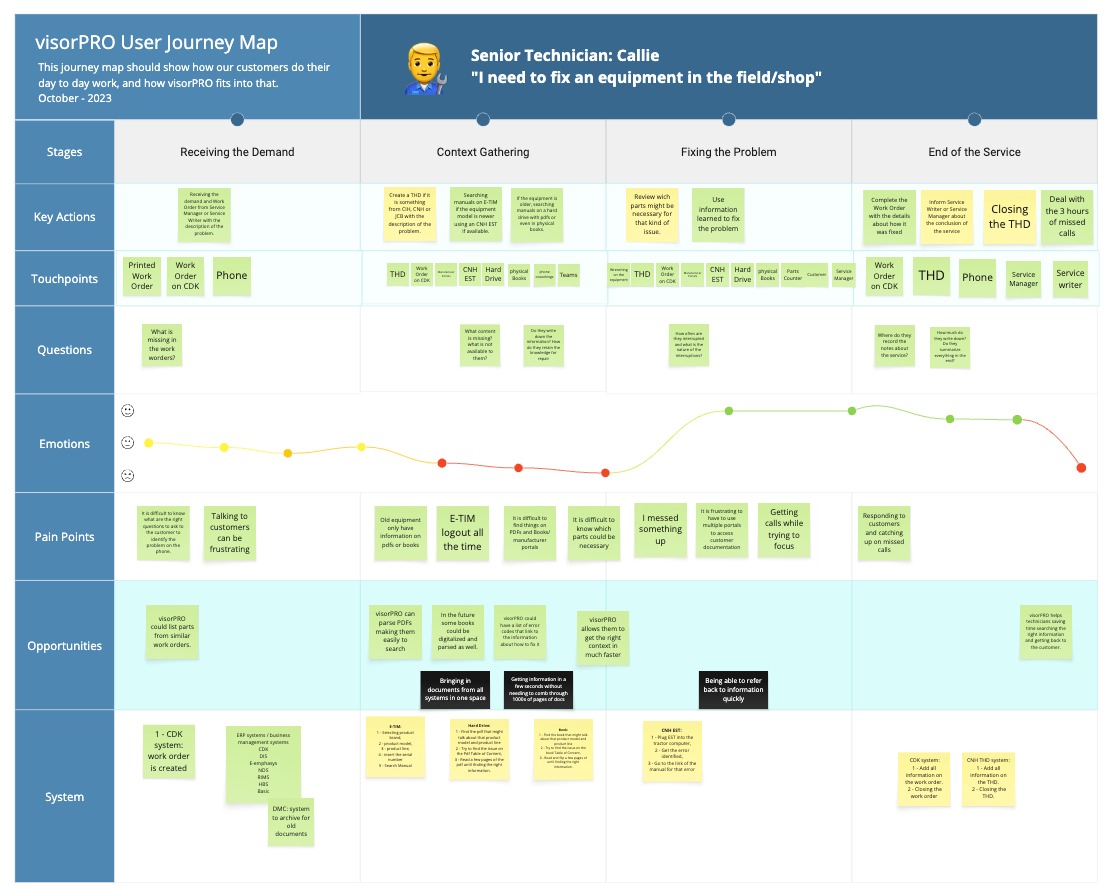
A client journey map highlighting the existing journey and pain points.
Ideation
Sharing ideas between departments in the discovery process.
With AI assistants being on the rise, we quickly learned that this could help us parse through thousands of documents and provide crucial information with sources.

Initial research into AI Assistants
The initial prototype of the Vi was strategically designed to emulate existing AI assistants, prioritizing user-friendliness and simplicity to enhance the overall experience.
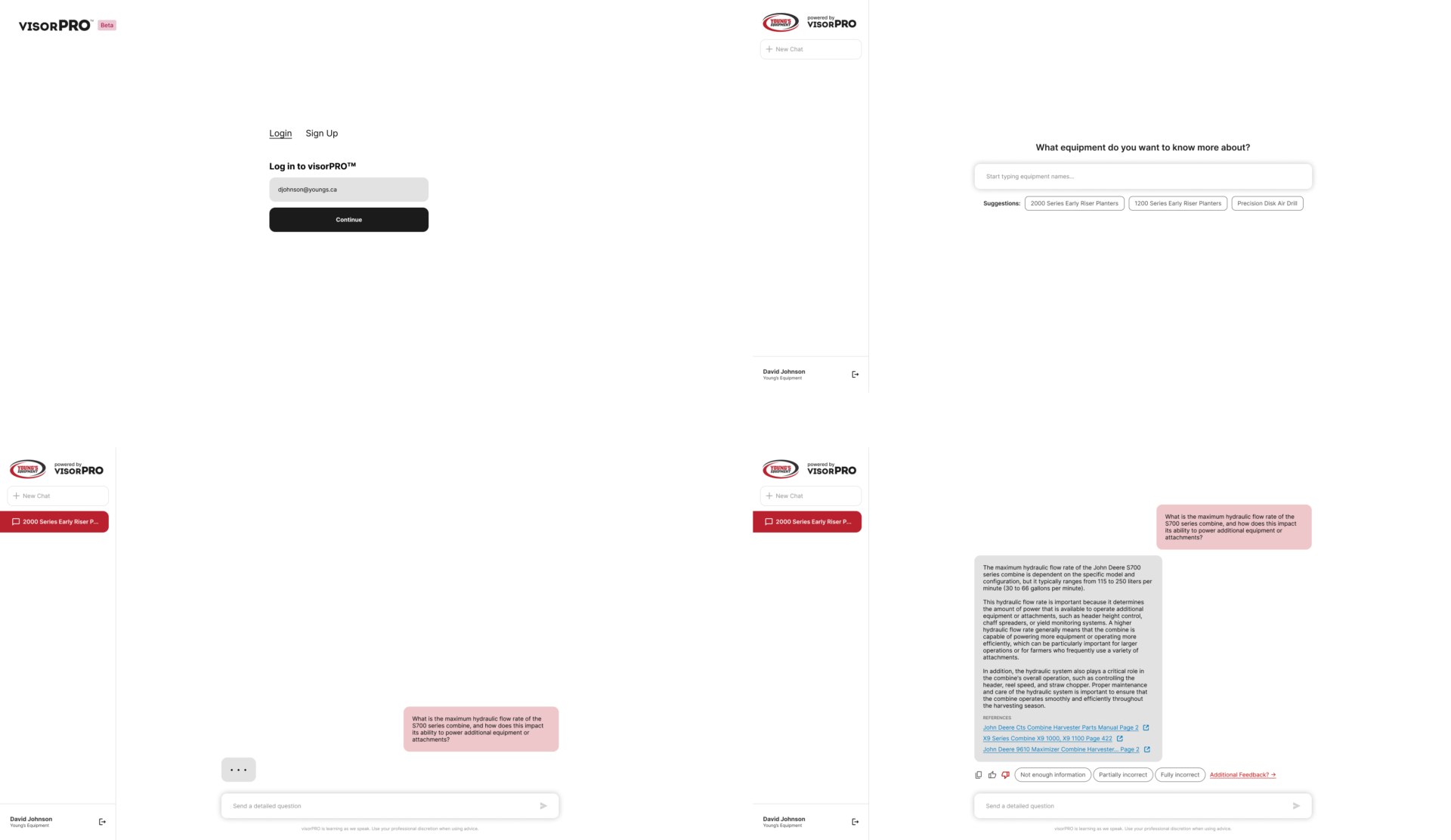
First set of wireframes completed during the ideation process
Testing
Trying to see how AI assistants can be improved to fit the workflow of service techs.
Since we had such a simple prototype to begin with, we conducted qualitative user interviews with service technicians and service managers to understand how we can make Vi fit into their day-to-day seamlessly.
Interview Highlights:
"Is there a way to find the source text so I can ensure accuracy?"
– Participant A from our qualitative user interview
"I almost never check my email. I don't even think I'm logged in."
– Participant B from our qualitative user interview
Iterations
Refining the prototype to meet user needs and concerns.
After receiving this feedback, we revisited the ideation, decision-making, and prototyping processes to refine the critical areas that caused user pain points.
We initially had email as the main authentication method, but after receiving feedback that email is rarely used in the service department. The switch to SMS authentication was natural to our user base’s regular routine.
Through our testing, we also saw that many of our test subjects were unfamiliar with the concept of speaking to an AI. Therefore, we included tips and exclaimers.
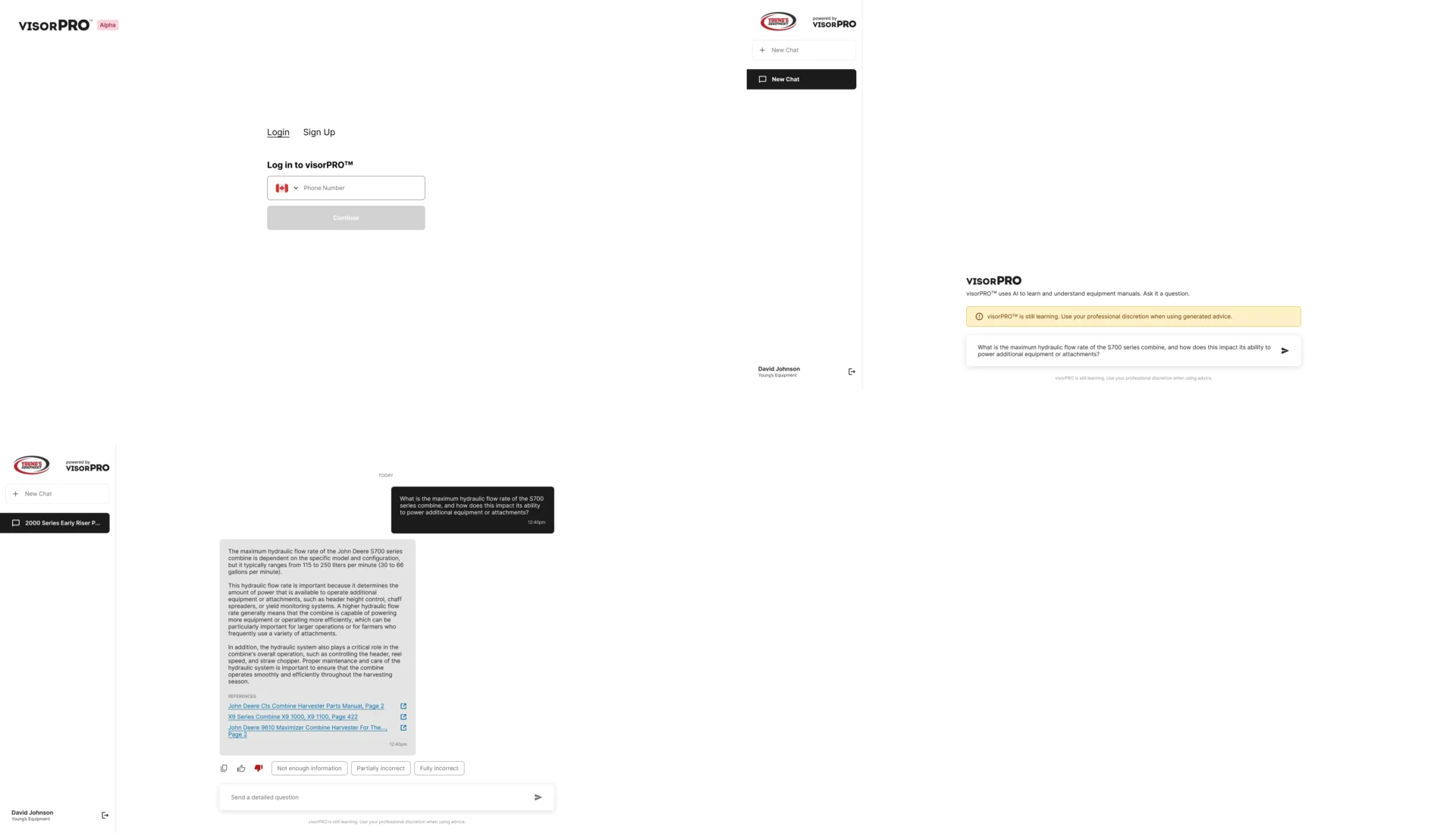
Second iteration of the prototype.
After our second round of user interviews, we noticed something. The common theme from our interviews came down to one thing:
"How do I ensure that the answers only come from documents I know are reliable?"
– Participant C from our third round of qualitative user interview
This question reflects concerns raised by our developers regarding ensuring Vi selects the correct documents for review. After analyzing user interactions with digital products, we observed that users clearly know the document type containing the information they need. Therefore, we implemented a Source Selector, empowering users to choose the documents used to generate their answers.
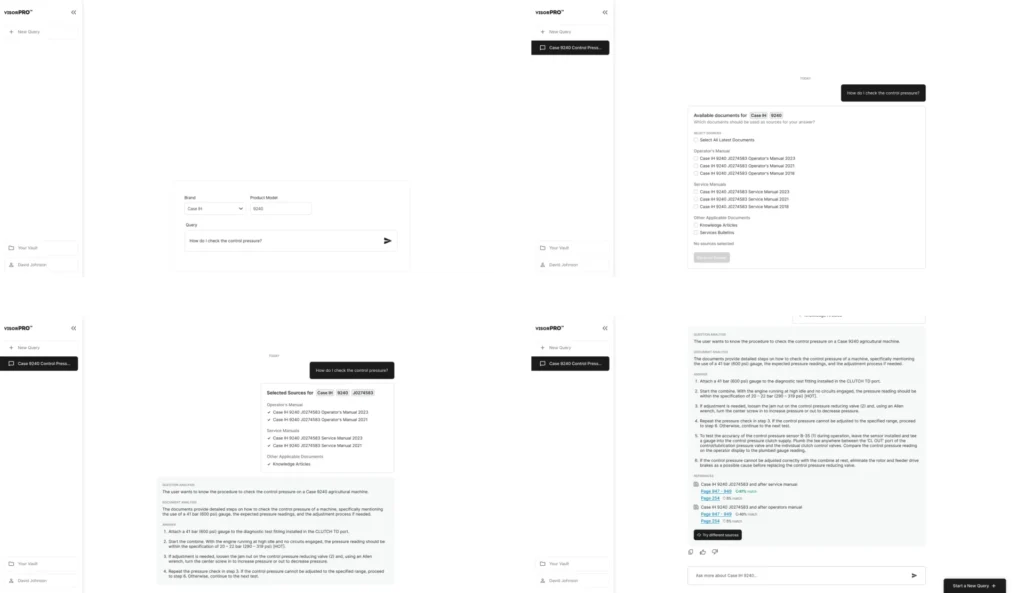
Final interation of the prototype.
Conclusion
Vi delivered 14,000+ solutions and saved 3,500+ hours for service techs in its first year.
Vi is an AI assistant that helps service technicians at agricultural dealerships quickly find reliable repair info without having to dig through complicated manuals or confusing portals. It makes their day-to-day work a lot smoother and saves them time.
Right after launch of our beta, we signed up five dealership partners within the first month — a great sign that Vi was hitting the mark.
In its first year, Vi has reached the following milestones, proving it’s really making a difference on the ground.
14,000+
Solutions provided
3,500+
Hours saved for our partners
This project showed me how important it is to work closely with developers and users to build something simple, useful, and trusted — especially in industries that don’t always have easy tech solutions.
Reflection
The impact of close collaboration with developers in turning user insights into simple, trusted AI solutions.
Working on Vi taught me the value of deep collaboration—not just with users, but with developers who brought technical insights that shaped key features from the ground up. Partnering closely with our dev team helped me understand the constraints and possibilities of AI integration, allowing us to build a tool that was both feasible and deeply aligned with user needs.
Throughout the process, I also learned how to balance simplicity with capability, especially in an industry where trust and clarity are non-negotiable. By grounding our design in user research and cross-functional collaboration, we were able to create an AI assistant that feels intuitive, reliable, and genuinely useful in the real-world environments of service technicians.